The Brookstreet Intelligence AI Cake
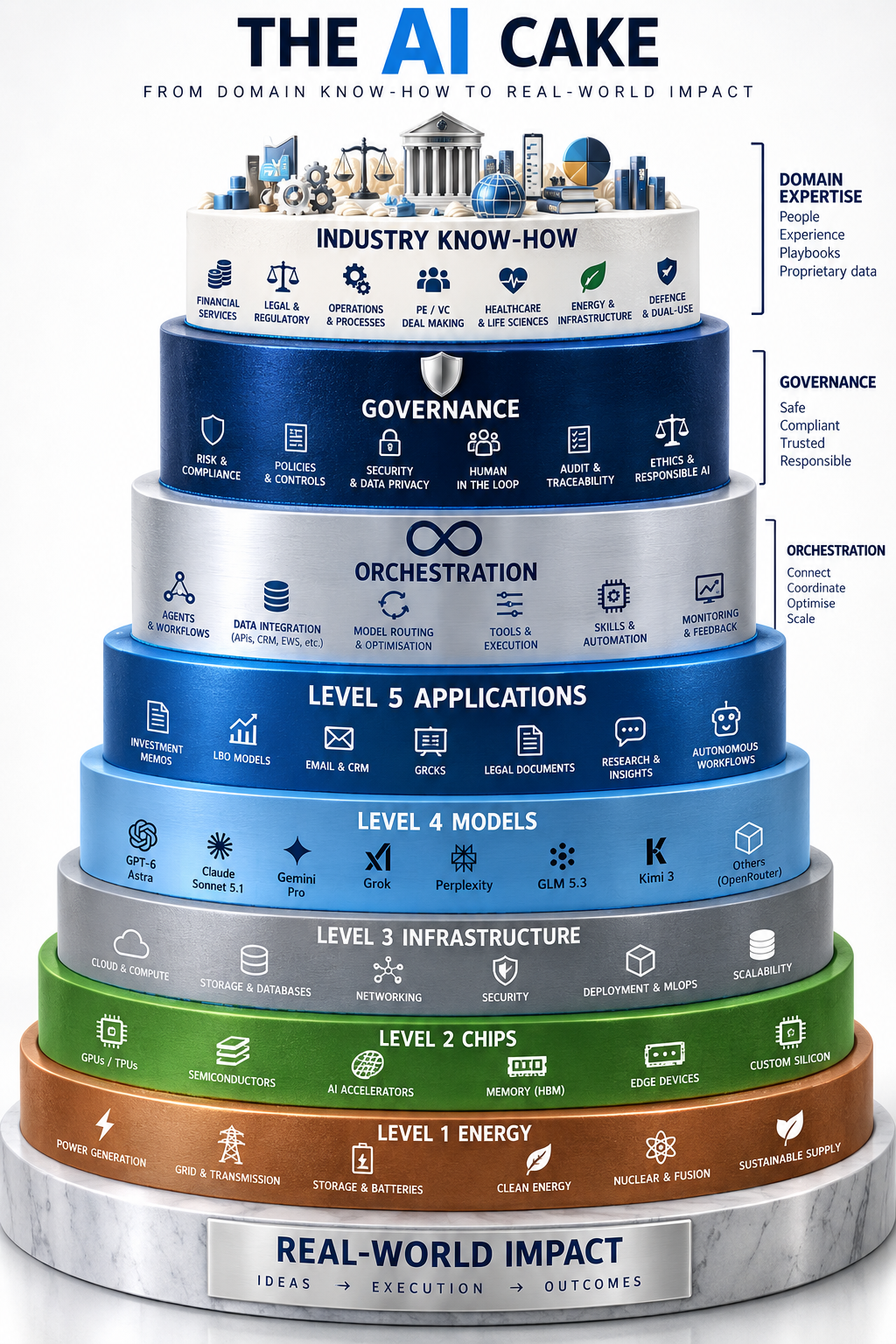
FROM NVIDIA’S FIVE-LAYER CAKE TO THE TOTAL AI CAKE
For the last few years, the AI investment story has often been told through one extraordinary company: NVIDIA.
Understandably so.
NVIDIA became one of the defining companies of the AI era because it sits at the heart of the compute revolution. But NVIDIA itself increasingly describes AI as something much larger than GPUs or even models.
Jensen Huang’s framing is simple and powerful:
Energy → Chips → Infrastructure → Models → Applications.
NVIDIA calls it the five-layer cake of AI. Each layer depends on the one beneath it, and all five have to scale together. Energy powers the chips. Chips power the infrastructure. Infrastructure runs the models. Models enable applications. NVIDIA Blog
At Brookstreet, we agree with that framework.
But we take it further.
For us, the investable AI economy does not stop at the five technical layers. The real opportunity is the total AI cake: the full system required to turn intelligence into measurable economic outcomes.
1. ENERGY
AI begins with electricity.
Power generation, grids, storage, nuclear, fusion, renewables, cooling and energy-management infrastructure are becoming strategic constraints on the growth of AI.
This is no longer peripheral infrastructure. It is foundational to the economics of intelligence.
NVIDIA itself now describes power and land as strategic resources for AI factories, while recent initiatives with Google and others are focused specifically on integrating large AI data centres more intelligently with electricity grids. NVIDIA Blog
2. CHIPS
GPUs, accelerators, HBM, networking silicon and custom compute are the engines that convert power into intelligence.
This is where NVIDIA built one of the most extraordinary businesses in modern history, but the opportunity extends across semiconductors, memory, interconnects, specialised accelerators and edge devices.
3. INFRASTRUCTURE
The chips then need somewhere to operate.
That means data centres, cloud, networking, storage, cooling, deployment infrastructure, security and increasingly the AI-factory architecture required to run thousands of processors as one coordinated system.
NVIDIA describes AI factories as infrastructure designed specifically to manufacture intelligence at scale. NVIDIA
4. MODELS
Above that sits the intelligence layer.
Frontier models, specialist models, multimodal systems, reasoning models, vision-language models and increasingly physical-AI and scientific models are competing across capability, cost, latency, context, autonomy and specialisation.
But Brookstreet’s view is that models themselves will increasingly become interchangeable.
The strategic question is no longer simply:
Which model wins?
It is:
How do you continuously use the best available model for each task?
That is the logic behind Brookstreet Intelligence 2.0: multi-model, multi-council, multi-agent architecture, with dynamic model selection and institutional memory sitting above individual engines. Brookstreet Equity Partners LLP
5. APPLICATIONS
This is where intelligence becomes economically useful.
AI applied to:
Financial services.
Healthcare and longevity.
Defence and dual-use technologies.
Legal and regulatory workflows.
Engineering.
Scientific discovery.
Robotics.
Autonomous systems.
Industrial processes.
Investment management.
Applications are where models become businesses.
But even this is not the end of the stack.
6. ORCHESTRATION
This is the layer that connects intelligence to action.
Agents.
Tools.
APIs.
Workflow automation.
Model routing.
Institutional memory.
Monitoring.
Execution.
This is where AI stops being something you ask questions and starts becoming something capable of performing work.
Brookstreet Intelligence 2.0 is designed precisely around this principle: models are components; orchestration is the operating system.
7. GOVERNANCE
For institutional adoption, intelligence without control is not enough.
AI systems need:
Risk controls.
Security.
Data privacy.
Audit trails.
Human oversight.
Compliance.
Responsible-AI frameworks.
In regulated environments such as investment management, financial services, healthcare and defence, governance is not an optional layer.
It is part of the architecture.
8. DOMAIN EXPERTISE
And then comes the part the technology industry sometimes underestimates.
AI without domain knowledge is generic.
Real-world value comes when intelligence is combined with:
People.
Experience.
Playbooks.
Proprietary data.
Investment judgement.
Sector expertise.
At Brookstreet, this means applying AI through the lens of private equity, venture capital, financial services, healthcare, legal/regulatory frameworks, energy and defence.
That is why our own architecture does not begin or end with models.
It begins with the physical stack and finishes with real-world impact.
THE TOTAL AI CAKE
So our expanded framework becomes:
Energy
→ Chips
→ Infrastructure
→ Models
→ Applications
→ Orchestration
→ Governance
→ Domain Expertise
→ Real-World Impact
The investment implication is important.
The AI opportunity is not one stock.
It is not one GPU.
It is not one model.
And it is certainly not one chatbot.
It is a complete industrial system.
The companies that generate the largest economic value may emerge at every layer of that system — from nuclear power and data centres to semiconductors, frontier models, autonomous agents, vertical applications and the orchestration platforms connecting them all.
NVIDIA helped define the five-layer cake.
At Brookstreet, we are interested in the whole cake.
Brookstreet Intelligence 2.0 is designed to sit across it: connecting data, intelligence, research, models, agents and execution across the investment lifecycle.
From energy to intelligence.
From intelligence to execution.
From execution to impact.
That is the AI economy we are building for.
Governance
Model Agility
Real World Applications
Full-Stack AI / The AI Cake