Brookstreet AI Academy for our PE/VC Professionals
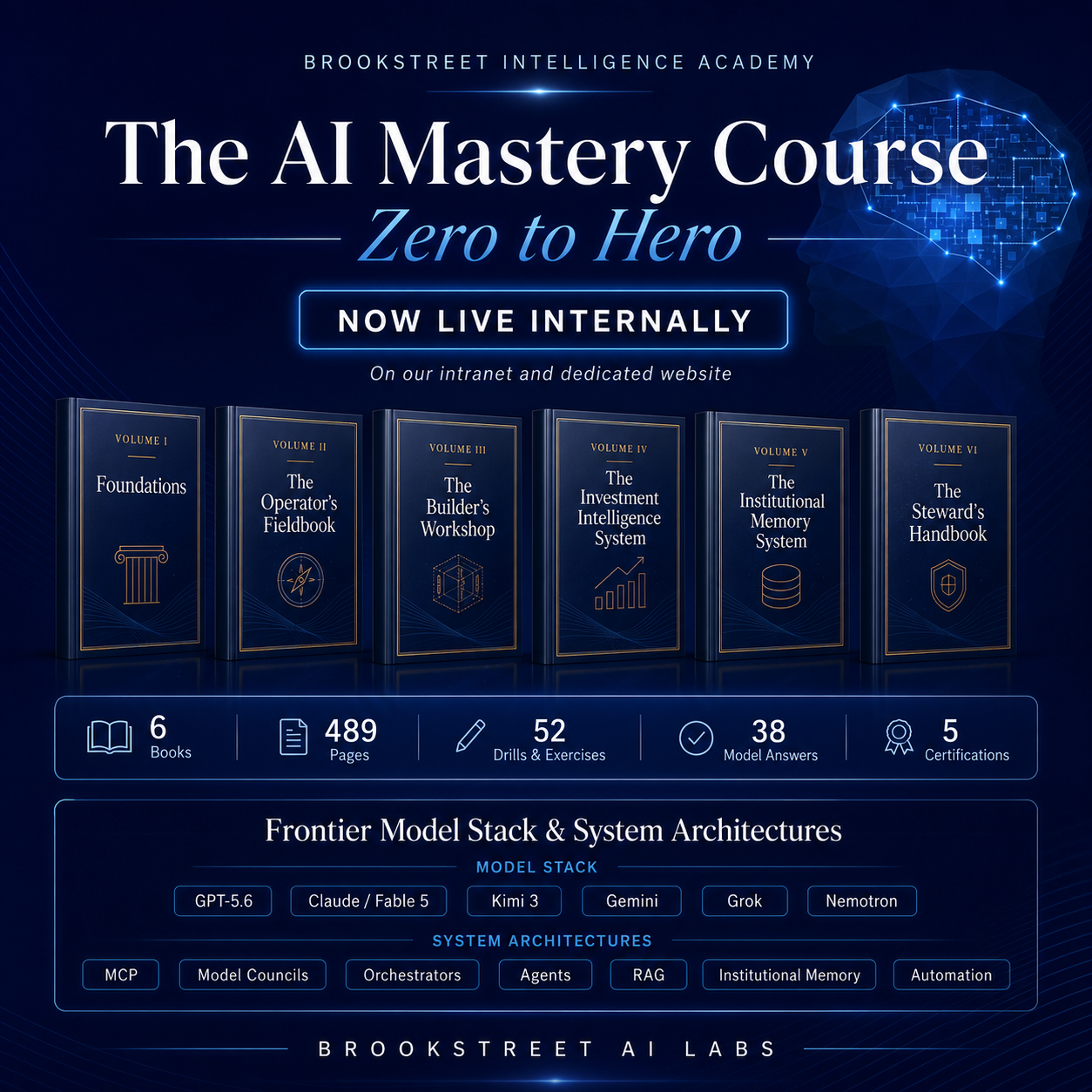
Brookstreet Launches The AI Mastery Course
Six books. One institutional operating system for mastering artificial intelligence in private capital.
Brookstreet Equity Partners LLP has launched its AI Mastery Course, a comprehensive internal programme designed to take our private capital professionals from the foundations of modern AI to the design, deployment and governance of institutional AI systems.
Developed through Brookstreet AI Labs and now available through the firm’s intranet and dedicated Academy website, the programme is not limited to prompting or general AI awareness. It teaches how models, agents, tools, institutional memory, investment workflows and human judgement can be combined into a coherent and governed operating system.
The initial release comprises:
6 books
489 pages
136 figures
634+ course and companion files
52 drills and exercises
38 model answers
5 progressive certifications
The curriculum introduces leading frontier systems—including GPT-5.6, Claude and Fable 5, Kimi 3, Gemini, Grok and Nemotron—while teaching the architectures that increasingly matter more than any individual model: Model Context Protocol, retrieval-augmented generation, agents, model councils, orchestrators, automation and institutional memory.
The six-volume pathway
Volume I — Foundations
How modern AI actually works
The first volume establishes the conceptual and technical foundation for the entire programme.
It explains models, tokens, context windows, prompting, reasoning, multimodal systems, hallucinations, research, verification, retrieval, memory, APIs, MCP, tools, agents and orchestration in practical language.
It also introduces the central Brookstreet principle that access to frontier models is becoming commoditised. The enduring advantage lies in the architecture, proprietary memory, operating discipline and judgement built around them.
Learners finish Volume I understanding:
What modern AI systems can and cannot do.
How models generate answers.
Why confident output may still be wrong.
How prompting, context, retrieval and tools interact.
The difference between models, platforms, agents and orchestrators.
Why humans must remain accountable for consequential decisions.
How Brookstreet Intelligence combines these components institutionally.
Completion establishes the Foundation Practitioner level.
Volume II — The Operator’s Fieldbook
Reliable daily work, sourced and verified
Volume II turns understanding into professional output.
It teaches participants how to use AI for research, document analysis, spreadsheets, numerical work, executive writing, presentations and everyday institutional tasks—without sacrificing accuracy, confidentiality or accountability.
The volume is structured around the Operator’s Loop:
Frame the task> source the evidence> verify the facts>produce the output>record the work>pass the human gate.
Learners practise how to:
Produce evidence-backed research.
Analyse long and complex documents.
Extract and reconcile information.
Work safely with financial data and spreadsheets.
Compare conflicting document versions.
Draft investment and executive materials in firm voice.
Identify hallucinations, unsupported claims and hidden assumptions.
Know when to stop and escalate to a human decision-maker.
Passing the practical assessment certifies the learner as a Brookstreet AI Operator.
Volume III — The Builder’s Workshop
From individual tasks to governed systems
Volume III teaches experienced Operators how to transform a successful manual process into a repeatable AI-enabled system.
The emphasis is not software engineering for its own sake. It is the discipline of specifying, connecting, testing and safely commissioning workflows that colleagues and the institution can trust.
The volume covers:
Workflow discovery and process mapping.
APIs, structured data and JSON.
MCP servers, clients and permissions.
Retrieval and knowledge architecture.
Skills, automations and autonomous agents.
Model routing and orchestration.
Human approval gates.
Golden datasets and evaluations.
Logging, observability and cost monitoring.
Error handling, rollback and kill switches.
Security, prompt injection and least-privilege access.
Learners build governed systems that are:
Specified, scoped, tested, observable, reversible and owned by a named human.
Certification requires the learner to deliver a working system that another colleague can use, earning the Brookstreet AI Builder designation.
Volume IV — The Investment Intelligence System
AI applied across the complete investment lifecycle
Volume IV applies the full AI architecture to the work Brookstreet exists to perform: investing.
It follows the investment lifecycle from thesis development through sourcing, diligence, transaction execution, portfolio management, exit and realised returns.
The volume covers:
Sector thesis creation and revision.
Market mapping and company discovery.
Deal sourcing and relationship-path analysis.
Screening and mandate fit.
Commercial, financial, technical, legal and management diligence.
Data-room extraction and contradiction detection.
Comparable companies, precedents and DCF support.
Scenario analysis, cap tables and waterfalls.
Investment Committee memorandum preparation.
Bull, bear and specialist challenge councils.
Decision records and dissent.
Term sheets, structuring and transaction execution.
Portfolio monitoring and value creation.
Board packs and performance reporting.
Fund construction, reserves and concentration.
LP reporting and due diligence questionnaires.
Exit readiness, buyer mapping and DPI attribution.
AI gathers evidence, extracts information, models scenarios, drafts materials and challenges assumptions. Partners and the Investment Committee retain every consequential decision right.
This volume forms the core investment component of the Architect pathway.
Volume V — The Institutional Memory System
Building the knowledge moat
Volume V addresses one of the most important limitations of ordinary AI use: systems that repeatedly begin without reliable institutional context.
It teaches how to build a proprietary, structured and continuously improving institutional memory—one that preserves what the firm has learned across transactions, relationships, portfolio companies and decisions.
The volume covers:
The distinction between documents and true institutional memory.
Canonical companies, people, funds, transactions and decisions.
Entity naming and deduplication.
Knowledge graphs and relationships.
Provenance and source lineage.
Retrieval architecture and testing.
Confidence, freshness and conflicting facts.
Approved memory write-back.
Distillation, correction and pruning.
Sensitive-data exclusions.
Access controls and information barriers.
Retention, portability, backup and recovery.
Session, project and institutional continuity.
Multi-team memory and controlled handovers.
The aim is to ensure that Brookstreet becomes more intelligent with every completed task and transaction rather than repeatedly starting from zero.
Volumes IV and V together certify the Brookstreet AI Architect: a professional capable of designing an integrated investment and institutional-memory vertical.
Volume VI — The Steward’s Handbook
Governance that permits greater capability
The final volume teaches how AI systems are governed, measured and operated once they become part of the institution.
Its central argument is that governance is not the brake on AI adoption. Good governance is what allows a firm to grant more capability with confidence because access, actions and potential failures are properly bounded.
The volume covers:
The AI Committee and system ownership.
Named Stewards for live systems.
AI-use, vendor, model and connector registers.
Risk classification and materiality.
Data protection, cyber security and records.
Human oversight and decision rights.
Intellectual property and third-party risk.
Evaluations, drift and production monitoring.
Cost, performance and return on investment.
Change control and release management.
Incident classification and response.
Business continuity and recovery.
Certification, permissions and recertification.
Adoption, training and institutional trust.
The Steward owns a live AI system—its policy, budget, risk, performance and incident plan—and remains accountable for maintaining the institution’s trust.
Completion certifies the learner as a Brookstreet AI Steward.
A progressive certification ladder
The programme is organised around five progressively demanding levels:
Foundation Practitioner — understands the system and its limits.
Operator — produces sourced, verified and professional work.
Builder — ships governed systems that colleagues can operate.
Architect — designs integrated investment and memory systems.
Steward — owns live systems and protects institutional trust.
Reading establishes understanding. Certification requires practical exercises, model-answer comparison, human assessment and demonstrated competence before additional permissions are granted. The programme’s infographic summarises this five-rung pathway and the doctrine connecting all six volumes.
The Brookstreet AI Doctrine
Five principles run through the entire programme:
Architecture over models.
Fluent is not true.
A human is always accountable.
Memory is the moat.
Grant power as you govern it.
Built for the realities of private capital
The programme has been designed specifically around the needs of investment professionals rather than adapted from a generic technical course.
Its worked cases and practical materials address real institutional activities including:
Investment research and thematic intelligence.
Sourcing and screening.
Data-room diligence.
Valuation and structuring.
Investment Committee preparation.
Portfolio monitoring.
Investor reporting.
Institutional knowledge retention.
AI governance and operational resilience.
Leadership perspective
Omiros D. Sarikas, Founder and Managing Partner of Brookstreet Equity Partners LLP, said:
“The (AI) advantage will not belong to firms that merely subscribe to the strongest model. The same models will increasingly be available to everyone. The durable advantage will belong to institutions that build the best architecture, proprietary memory, judgement and governed systems around them.
The AI Mastery Course captures how we believe private capital professionals must learn to operate: understanding the technology, applying it to real investment work, verifying every important output and retaining human accountability for every decision that matters.”
Internal availability
The AI Mastery Course: Zero to Hero is now available internally through the Brookstreet intranet and dedicated Intelligence Academy website.
The initial release is intended for Brookstreet professionals, selected advisers and approved participants following either:
The Reader Route, through which the six books can be read independently as a complete professional guide; or
The Certification Route, which includes the exercises, case packs, model answers, capstones and human assessment required to demonstrate competence.
Brookstreet Intelligence 2.0